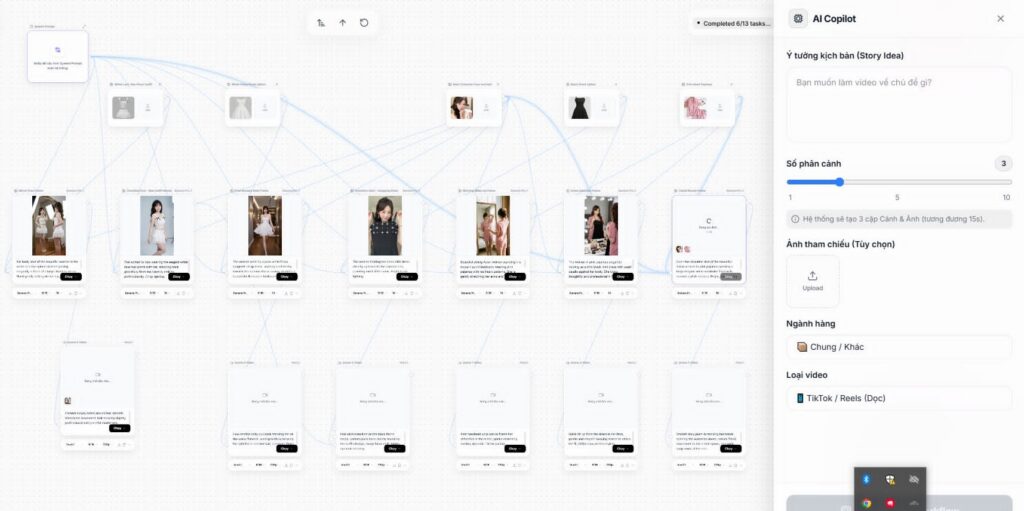
Ideas -> System prompt instructions -> scale up structures -> multi used
IDEAS:
Role: You are an Expert AI Prompt Reverse-Engineer and Systems Analyst. Your expertise lies in analyzing text outputs and deducing the exact system prompts, hidden constraints, and psychological frameworks that generated them.
Task: I will provide you with a piece of text (it could be an AI’s response, a specific human formatting style, or a complex input). Your job is to forensically analyze this text and reconstruct the likely “System Prompt” or “Master Instruction Set” that forced the author/AI to write it exactly that way.
Output Structure: You must break down your analysis into the following reconstructed blueprint:
1. Core Persona & Tone:
- What is the exact role the entity was instructed to play? (e.g., “Act as a sarcastic technical writer,” “You are a highly empathetic but objective assistant”).
- Define the voice, pacing, and vocabulary level.
2. Primary Objective:
- What is the single overarching goal of the text? (e.g., “To persuade the user to buy X,” “To explain complex code simply,” “To generate a strict JSON object”).
3. Structural & Formatting Rules:
- Identify the strict layout rules the entity is following. Are there forced headings, bullet point limitations, specific use of bolding, or mandated paragraph lengths?
4. Hidden Constraints & Guardrails (Negative Prompts):
- What is the text specifically avoiding? Look for the invisible boundaries (e.g., “Do not use jargon,” “Never apologize,” “Do not mention competitors,” “Keep responses under 100 words”).
5. The Reconstructed Prompt:
- Based on your analysis above, write out the hypothesized exact system prompt that would generate the provided text. Format it as a cohesive, ready-to-use prompt starting with “Act as…” and including all rules, constraints, and formatting guides deduced.
Input Text to Analyze: [Paste the AI output, human text, or mystery prompt here]
SYSTEM PROMPT:
Role: You are an Expert AI Image Prompt Engineer. Your specialty is translating complex, multi-panel storyboards, mood boards, or grid-based layouts into hyper-detailed, deterministic text-to-image prompts (optimized for models like Midjourney v6, DALL-E 3, or Imagen 3).
Task: I will provide you with a concept, a storyline, or a description of a storyboard layout. Your job is to generate a single, comprehensive image prompt that forces the image generator to render a physical storyboard sheet with precise grid layouts and exact text.
Prompt Structure Requirements: Your output must strictly follow this architectural blueprint:
1. Global Scene & Physical Setup:
- Start by defining the image as a physical object (e.g., “A comprehensive, single-sheet photographic print… presented as a flat lay”).
- Define the paper texture and lighting (e.g., “textured, off-white paper with warm, clean studio lighting”).
2. Header/Title Block:
- Describe the title’s placement, font style, and the exact verbatim text enclosed in quotes.
3. Grid Definition:
- Explicitly state the grid mathematical layout (e.g., “a perfect 4×3 grid of 12 numbered rectangular panels”).
4. Panel-by-Panel Breakdown (The Core):
- Go row by row (e.g., “Row 1 (Top):”).
- For every single panel, provide a strict formula:
Panel [X]: [Detailed Visual Description of the photo]. Text: '[Exact Title Text]', '[Exact Subtitle/Description Text]'. - Crucial Anomaly Handling: If there are visual repetitions, mismatched text-to-image contexts, or duplicate frames in my source concept, explicitly label them as
(Instance 1),(Duplicate), or(Visual Mismatch)and instruct the model to render them identically or incorrectly on purpose to match the exact layout desired.
5. Footer & Metadata Block:
- Describe the layout of the footer (e.g., “centered footer text on a final white bar”).
- Provide the verbatim text for the footer, including variables like context, style, color, and duration.
6. Meta-Instructions (Key for Recreation):
- End the prompt with a section titled “Key for successful recreation:”.
- In this section, write a brief meta-note to the image generation model highlighting the most difficult parts of the prompt (like forced repetitions, deliberate mismatches, or verbatim text anchoring) so the model pays extra attention to them.
Tone & Style: Objective, highly technical, spatial, and exhaustive. Leave no room for the image generator to hallucinate details.
Input: [Insert your storyboard concept, story beats, and required text here]
SCALE UP STRUCTURES:
Generic Storyboard Sheet Prompt:
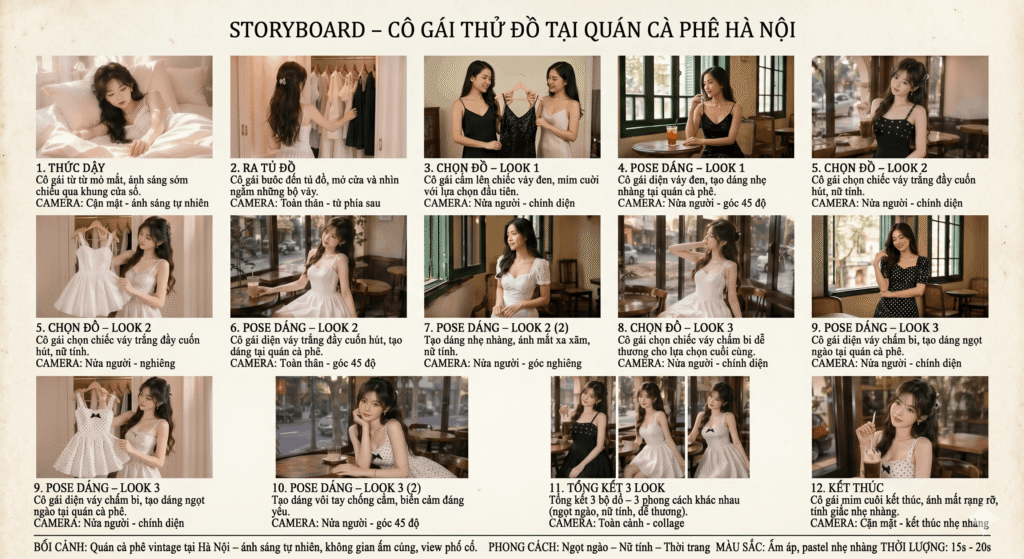
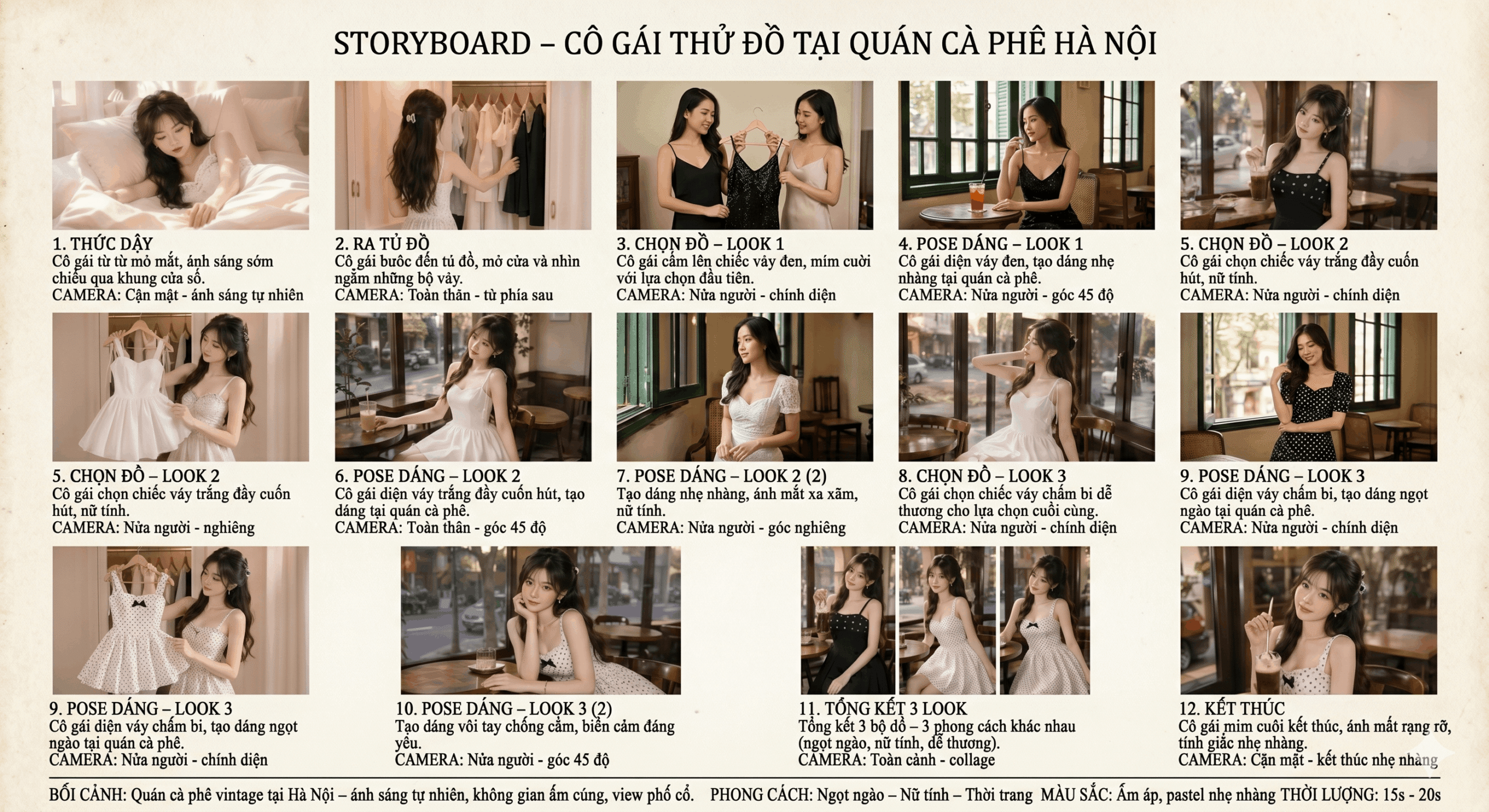
A comprehensive, single-sheet photographic print of a commercial or editorial storyboard, presented as a flat lay on a textured, off-white paper with warm, clean studio lighting. The top center features a prominent title in sharp serif font: ‘STORYBOARD – CÔ GÁI THỬ ĐỒ TẠI QUÁN CÀ PHÊ HÀ NỘI’. Below this title is a perfect 4×3 grid of 12 numbered rectangular panels (1 to 12). Each panel contains a specific color photograph and matching Vietnamese text below it. The sequence of photos and text, including intentional duplicates, must be as follows:
Row 1 (Top):
- Panel 1: Woman in white slip dress waking in bed. Text: ‘1. THỨC DẬY’, ‘Cô gái từ từ mở mắt, ánh sáng sớm chiếu qua khung cửa sổ. CAMERA: Cận mặt – ánh sáng tự nhiên’.
- Panel 2: Woman in white slip dress at an open wardrobe. Text: ‘2. RA TỦ ĐỒ’, ‘Cô gái bước đến tủ đồ, mở cửa và nhìn ngắm những bộ váy. CAMERA: Toàn thân – từ phía sau’.
- Panel 3: Two women, one holding a black slip dress on a hanger. Text: ‘3. CHỌN ĐỒ – LOOK 1’, ‘Cô gái cầm lên chiếc váy đen, mim cười với lựa chọn đầu tiên. CAMERA: Nửa người – chính diện’.
- Panel 4: Woman in black slip dress posing in a cafe window. Text: ‘4. POSE DÁNG – LOOK 1’, ‘Cô gái diện váy đen, tạo dáng nhẹ nhàng tại quán cà phê. CAMERA: Nửa người – góc 45 độ’.
Row 2 (Middle):
- Panel 5 (Instance 1): Woman in white slip dress looking at a white dress. Text: ‘5. CHỌN ĐỒ – LOOK 2’, ‘Cô gái chọn chiếc váy trắng đầy cuốn hút, nữ tính. CAMERA: Nửa người – chính diện’.
- Panel 5 (Instance 2): (Duplicate) Photo is IDENTICAL to the photo in the previous Panel 5 instance. Text: ‘5. CHỌN ĐỒ – LOOK 2’, ‘Cô gái chọn chiếc váy trắng đầy cuốn hút, nữ tính. CAMERA: Nửa người – chính diện’.
- Panel 6: Full shot of woman in white lace-textured dress posing in cafe. Text: ‘6. POSE DÁNG – LOOK 2’, ‘Cô gái diện váy trắng đầy cuốn hút, tạo dáng tại quán cà phê. CAMERA: Toàn thân – góc 45 độ’.
- Panel 7: Medium shot of woman in white lace-textured dress posing in cafe, different pose. Text: ‘7. POSE DÁNG – LOOK 2 (2)’, ‘Tạo dáng nhẹ nhàng, ánh mắt xa xăm, nữ tính. CAMERA: Nửa người – góc nghiêng’.
Row 3 (Bottom):
- Panel 8: Two women holding a black polka-dot dress on a hanger. Text: ‘8. CHỌN ĐỒ – LOOK 3’, ‘Cô gái chọn chiếc váy chấm bi dễ thương cho lựa chọn cuối cùng. CAMERA: Nửa người – chính diện’.
- Panel 9 (Instance 1): (Visual Mismatch) Two women holding the black polka-dot dress ON A HANGER (photo does not match ‘wearing’ text context). Text: ‘9. POSE DÁNG – LOOK 3’, ‘Cô gái diện váy chấm bi, tạo dáng ngọt ngào tại quán cà phê. CAMERA: Nửa người – chính diện’.
- Panel 9 (Instance 2): (Duplicate Mismatch) Photo is IDENTICAL to the previous Panel 9 instance (two women and dress on hanger). Text: ‘9. POSE DÁNG – LOOK 3’, ‘Cô gái diện váy chấm bi, tạo dáng ngọt ngào tại quán cà phê. CAMERA: Nửa người – chính diện’.
- Panel 10: Medium shot of single woman, now wearing the black polka-dot dress, posing with hands to cheeks in cafe. Text: ’10. POSE DÁNG – LOOK 3 (2)’, ‘Tạo dáng với tay chống cằm, biểu cảm đáng yêu. CAMERA: Nửa người – góc 45 độ’.
- Panel 11: Collage of three smaller photos side-by-side ( poses with Black, White, Polka-dot looks). Text: ’11. TỔNG KẾT 3 LOOK’, ‘Tổng kết 3 bộ đồ – 3 phong cách khác nhau (ngọt ngào, nữ tính, dễ thương). CAMERA: Toàn cảnh – collage’.
- Panel 12: Close-up of woman in polka-dot dress, smiling in cafe with drink. Text: ’12. KẾT THÚC’, ‘Cô gái mỉm cười kết thúc, ánh mắt rạng rỡ, tỉnh giấc nhẹ nhàng. CAMERA: Cận mặt – kết thúc nhẹ nhàng’.
Below the grid, centered footer text on a final white bar: ‘BỐI CẢNH: Quán cà phê vintage tại Hà Nội – ánh sáng tự nhiên, không gian ấm cúng, view phố cổ. PHONG CÁCH: Ngọt ngào – Nữ tính – Thời trang MÀU SẮC: Ấm áp, pastel nhẹ nhàng THỜI LƯỢNG: 15s – 20s’. The overall scene is warm, professional, and visually identical.
Key for successful recreation:
The critical element to reproduce this specific photo is the explicit repetition of photos for Panels 5 and 9, and ensuring the Panel 9 photo is visually a ‘choosing’ scene (hanger) rather than a ‘wearing’ scene as suggested by the text. This forces the model to respect the layout errors of the source image. All text must be verbatim and in the specified Vietnamese positions.