
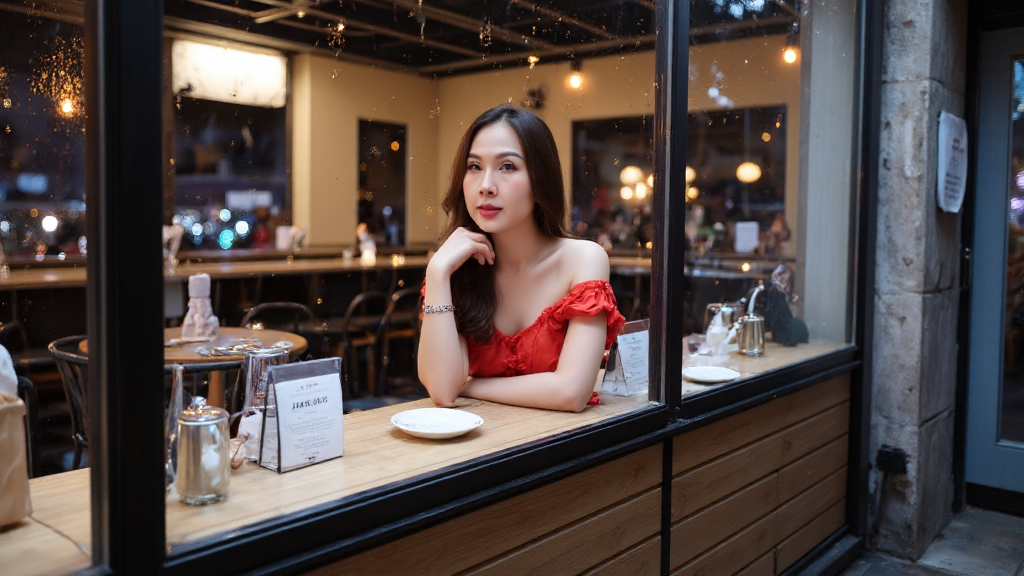
Lately, I’ve become obsessed with capturing the feeling of looking through glass — that quiet, suspended distance between the world outside and the person within.
The idea grew from a blend of influences:
Edward Hopper’s Nighthawks, with its lonely warmth glowing against the night;
Amili Huang’s cinematic, story-driven imagery;
and 舒飛的《戰場日記》 — where every frame reads like memory etched in reflection.
When I first tried to recreate this feeling using local AI photo generation, I hit a wall. The glass never looked right — it either obscured the subject or shattered the mood. The real turning point came when I stopped writing technical prompts and started writing in the language of poetry and scene-building.
That shift brought the image to life:
A cinematic full-body portrait, head to toe, of a young Asian woman in her thirties — long brown curls falling softly — seated gracefully inside a warm café at night. The camera is pressed against the glass from outside; rain-speckled window panes veil her in shimmering reflections. Beyond her, city lights blur and dissolve into dreamlike haze, their glow merging with her silhouette — glass dividing warmth from the restless night.
Her posture is serene, her outfit visible from head to toe, bathed in the café’s golden light. Her calm brown eyes and tender expression glow through the pane, while the outside world fades into silhouettes and soft bokeh. It feels like a film still of intimacy and distance — moody, dramatic, with light tracing her skin like a masterstroke of shadow and radiance. 8K photorealistic detail, but alive with emotion.
I’ve come to realize it’s less about writing prompts for machines, and more about writing scenes for people — telling the AI a story. That’s when the image finally breathes.


